High-wall split heat pumps are the default in NZ homes - but they're not always the best option. If you've got low windows, limited wall space, or an older home where mounting a unit high on the wall is impractical, a floor console heat pump is often the smarter choice. Here's the complete guide to when they make sense, which models to look at, and what to expect from the install.
1. What is a floor console heat pump?
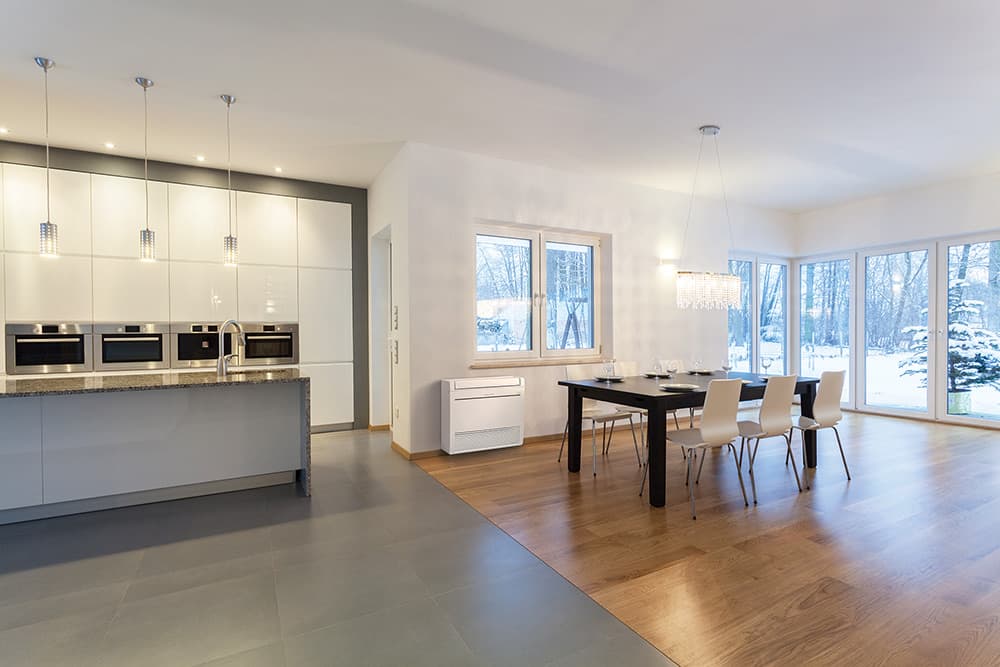
A floor console (also called a floor standing unit) is a split heat pump where the indoor unit sits on or near the floor instead of being mounted high on a wall. It connects to a standard outdoor compressor unit via refrigerant lines, just like a high-wall split. The unit is typically about 600mm tall, 700mm wide, and 200mm deep - roughly the footprint of an old panel heater.
Floor consoles blow warm or cool air upward and outward from floor level. For heating, this is actually more natural than a high-wall unit blowing warm air downward - heat rises, so you get a more even temperature throughout the room with less stratification.
2. When to choose floor console over high-wall
Floor consoles solve specific problems that high-wall units can't. You should seriously consider one if:
- Low windows or ranch sliders: no wall space above the window frame for a high-wall unit, but the wall below the sill is perfect for a floor console
- Older homes with no clearance: villas, bungalows, and 1960s-70s homes often have picture rails, low ceilings, or wall framing that makes high-wall mounting awkward or ugly
- Conservatories and sunrooms:glass walls mean there's nowhere to mount a high-wall unit - a floor console fits under the glazing
- Bedrooms with limited wall options: if the only available wall puts a high-wall unit directly above the bed, a floor console across the room is a better layout
- Heating-dominant rooms: the upward airflow from a floor console distributes heat more evenly than warm air blowing down from ceiling height
- Accessibility: filters and controls are at a reachable height - no step ladder needed for cleaning
3. Pros and cons vs high-wall
Floor consoles and high-wall units have the same core technology - same compressor, same refrigerant cycle, similar efficiency. The differences are practical:
Advantages of floor console:
- Fits under windows and in rooms where high-wall is impractical
- Better heat distribution - warm air rises naturally from floor level
- Easy filter access for cleaning (no ladder)
- Less visually intrusive than a large high-wall unit in some room layouts
- Some models offer dual-discharge (top and bottom) for faster room conditioning
Disadvantages of floor console:
- Takes up floor space - you can't push furniture flush against the wall where it's installed
- Slightly higher cost than a comparable high-wall model (typically $300-$600 more)
- Cooling performance can be slightly less even - cool air stays low and doesn't always circulate as well as from a high-wall unit
- Fewer model choices - most brands have a smaller floor console range compared to high-wall
- Small children and pets have direct access to the unit
4. Key models available in NZ
Three brands dominate the floor console market in New Zealand. All are reliable - your choice depends on the capacity you need and which brand your installer supports best.
Mitsubishi Electric MFZ-KJ series
The go-to floor console for most NZ installers. Available in 2.5 kW, 3.5 kW, and 5.0 kW capacities. The MFZ-KJ25 is popular for bedrooms and smaller living rooms; the MFZ-KJ50 handles larger open-plan spaces. HyperCore variants maintain rated output down to -15C outdoor temperature - overkill for most of the Waikato, but useful for South Island or alpine locations. Quiet operation (19 dBA on low), Wi-Fi control available, and a clean compact design. As an authorised Mitsubishi Electric dealer, this is the series we install most.
Daikin FVXS series
Daikin's floor console range is well-regarded and available in 2.5 kW to 5.0 kW capacities. Slim profile design, good efficiency ratings, and Daikin's strong parts availability in NZ. The FVXS units feature a two-way airflow option (discharge from both the top and the front) which helps with room circulation.
Fujitsu AGTV series
Fujitsu's compact floor console is a solid option, particularly in the smaller capacities. Available from 2.5 kW to 5.0 kW. Compact dimensions, reasonable noise levels, and competitive pricing. A good pick for bedrooms and smaller rooms where Fujitsu is the preferred brand.
5. Installation considerations
Floor console installs are straightforward for an experienced installer, but there are a few things specific to this unit type:
- Wall backing: the unit needs a flat wall section at least 700mm wide. Skirting boards may need to be trimmed or removed behind the unit
- Pipe routing: refrigerant pipes exit low on the wall (not high like a high-wall unit), so the pipe run to the outdoor unit is different. This can be simpler in some layouts (straight out through the wall at ground level) or more complex in others
- Condensate drainage: because the unit is at floor level, gravity drainage is trickier. Most installs need a small condensate pump to move water to a drain point - your installer should factor this in
- Clearance:you need 50-100mm clearance on each side and nothing blocking the top discharge. Don't plan on placing the unit inside a built-in cabinet
- Semi-recessed option: some models can be partially recessed into the wall cavity for a flush finish. This looks great but adds $200-$500 to the install for the carpentry work
6. Sizing your floor console
Sizing follows the same principles as high-wall heat pumps:
- Well-insulated modern home: ~0.1 kW per sqm
- Average insulation: ~0.13 kW per sqm
- Older draughty home: ~0.15 kW per sqm
Typical room-to-model matchups for the Waikato:
- Bedroom (12-18 sqm): 2.5 kW floor console (e.g. MFZ-KJ25)
- Medium living room (20-30 sqm): 3.5 kW floor console (e.g. MFZ-KJ35)
- Large living area (30-45 sqm): 5.0 kW floor console (e.g. MFZ-KJ50)
Adjust upward for high ceilings, large glazed areas, or poor insulation. For rooms larger than about 50 sqm, a single floor console is probably undersized - consider a ducted system or two units instead. A proper site visit and heat-loss calculation is always the best approach. Read our heat pump sizing guide for the full methodology.
Frequently asked questions
Are floor console heat pumps as efficient as high-wall units?
Floor consoles are very close in efficiency to their high-wall equivalents from the same brand and series. The main difference is airflow pattern, not energy use. A Mitsubishi Electric MFZ-KJ floor console has a comparable COP to the equivalent MSZ high-wall model. Where floor consoles can edge ahead is heating comfort - warm air rising from a low position heats the room more evenly than warm air blowing down from a high-wall unit.
Can you install a floor console heat pump under a window?
Yes - this is one of the most common reasons to choose a floor console. The unit sits neatly below the window sill, typically only 600mm tall, leaving the glass unobstructed. This is especially useful in living rooms with large ranch-slider windows or older homes with low window sills where a high-wall unit simply won't fit above the frame.
How noisy are floor console heat pumps?
Floor consoles run at similar noise levels to high-wall units from the same brand - typically 19-22 dBA on quiet mode for premium models like the Mitsubishi MFZ-KJ. Because they sit at floor level you may be more aware of the fan sound than a high-wall unit mounted above head height, but the actual decibel output is comparable.
What size floor console do I need for my room?
Sizing follows the same rules as high-wall units - roughly 0.1 kW per square metre for well-insulated rooms and 0.13-0.15 kW per sqm for older homes. Floor consoles are available from about 2.5 kW up to 7.1 kW heating capacity. For anything larger, a ducted system is usually a better fit than a single floor console.
Do floor console heat pumps need special installation?
They need a flat wall section at floor level and the same outdoor unit + refrigerant pipework as any split system. The main difference is the pipe connection exits low on the wall rather than high, so the installer needs clear access behind or beside the unit. Some models can be semi-recessed into a wall cavity for a flush finish, but this adds to the install cost.
Are floor console heat pumps good for bedrooms?
They work well in bedrooms, particularly where the bed head is on the only suitable wall for a high-wall unit - you don't want cold air blowing directly onto your pillow. Floor consoles sit to the side, usually under a window, and direct airflow across the room rather than straight down onto the bed. Noise levels on quiet mode are low enough for sleeping.